
The social determinants of listening

Working at the Open Society Foundations’ Public Health Program, we thought a lot about the social and the structural determinants of health. This relates to the fact that one’s health and ability to be healthy, has to do with much more than individual decisions and behaviour: what you eat, whether and how much you exercise, and so on. This individualistic approach is dominant in popular culture and rampant on social media – it often goes along with a lot of blaming and shaming, and selling of expensive products. It has also been a focus of a lot of traditional public health work and messaging: getting people to change their behavior – to use condoms, avoid sugary drinks, stop smoking, wear seatbelts…
Individual behaviour and decisions are important when it comes to health of course, but form only a small part of the picture. How can you decide to eat healthily if healthy food is unavailable or unaffordable? And you can eat all the healthy food you like, but if you live in a highly polluted area, your health and life expectancy are going to suffer. Systemic racism and other injustices (such as the legacies of colonialism) impact who has access to the social and systemic factors underlying good health, like access to healthy food and clean air – so ultimately, for people to be healthy, we need to work towards greater social justice overall.
This orientation – to the social and structural, the systemic, deeply informs my approach to listening. A lot of work and writing on listening is focused on individual or group actions – how can people learn to listen better? How can leaders listen, or students? There are projects focused on bringing individuals together to listen across various boundaries and areas of difference. All of this is really important and necessary. I’m interested in all of it too. And, it’s only part of the picture.
I’m particularly interested in how we might establish the kinds of social conditions and systems, infrastructure, and incentives that enable and encourage listening. Every incentive right now encourages and rewards speaking. School and university students are graded on participation - which in essence means: how much do they speak? Companies and organizations of all kinds tend to reward those who speak up, take up space and attention. Social media platforms reward those who post more frequently, or comment a lot. We are urged to speak up, speak out, shout down.
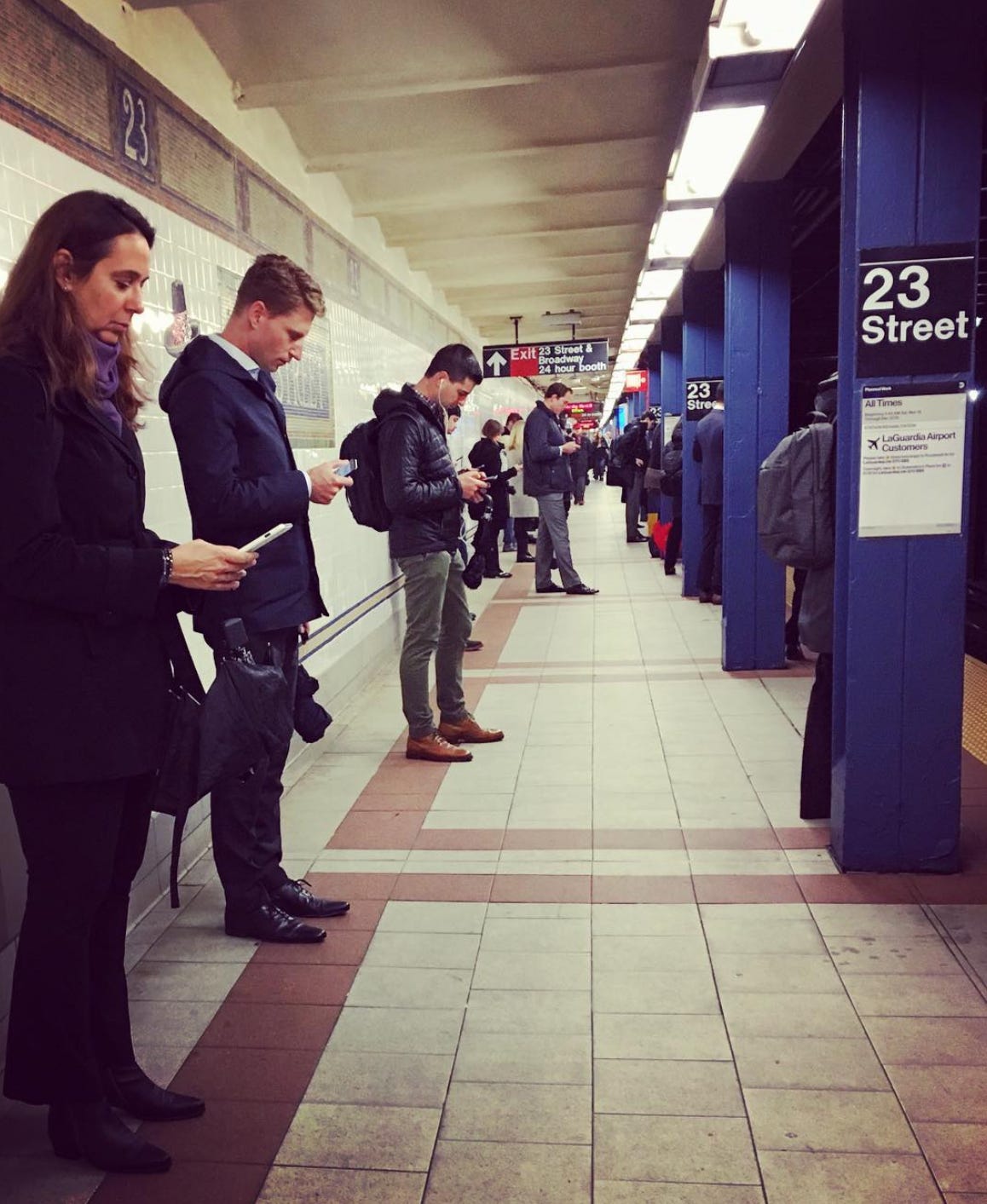
Even when we are listening, society and systems today encourage listening alone, rather than together - each in our own world. The Sony Walkman introduced this major shift back in 1979 and it’s possible to draw a direct trajectory from that to our algorithm-driven echo chambers of today. This Radiolab episode describes vividly just how much of a shock this new solo-listening technology was, at the time. Here’s part of the transcript, talking about the media launch of the Walkman. Invited journalists were each given a walkman to listen to and when they put on the headphones they heard a voice asking them to look out the window:
SIMON: And they see that they are not the only ones listening to a Walkman. There are dozens of other folks with orange headphones on moving through the park. Kids on roller skates ...
NORIKO ISHIGAKI: College students jogging, a woman exercising.
SIMON: People skateboarding, even a Buddhist monk. Like the scene that you and I see everyday walking down the streets, you know, people in their own little world listening to whatever they want to ...
JAD: Yeah.
SIMON: This is the first time anyone had ever seen that.
JAD: Amazing. Amazing.
SIMON: And of course, if they took their headphones off, they rejoin our shared world hearing the din of the park and the city around them. But then when they put them back on, they'd be back in their own little world. Headphones off, collective reality. Headphones on, whatever personal reality, whatever mood they've chosen for themselves.
JAD: Oh my God.
SIMON: Totally, yeah. And maybe you can communicate this better than me because you've lived it, but like this was all so new. Like most of these people had probably never worn headphones before. They've never had stuff pumped directly into their ears. They've never listened to something outside before, short of transistor radio or maybe a boombox. And they're now doing it altogether, but by themselves.
JAD: People don't really understand what—a big deal the Walkman was. Like, remember when Steve Jobs did the iPhone and everybody's like, "Oh my god, oh my god."
SIMON: Yep, yep.
JAD: This was like that times a thousand.
A few months ago I wrote about how my family and I used to listen to the radio together, in our family living room. Today, that same scene would more likely be a family in a living room, each viewing and listening to content on their own phones.
Sarah Stein Lubrano, in her recent book, Don’t Talk About Politics, highlights the importance of social infrastructure to our listening and our relationships (or lack of them): “Infrastructures are enabling systems: they create affordances, they encourage [and discourage] certain kinds of actions and interactions.”
Mindy Fullilove, a ‘social psychiatrist’, writes and talks about the role of space and space in our cities, and the possibilities for these to either divide or connect, facilitate community or separation – particularly when it comes to race. Nora Bateson writes about the importance of ecologies of communication.
We learn from all of these writers and thinkers and many others that like health, the state of our listening is not just up to each of us – it’s up to all of us, together. We need to maintain and create the systems and infrastructures and spaces and incentives that will enable all of us to listen more and better.
When it comes to listening initiatives to address isolation, polarisation and division it’s important not only to get individuals to talk and listen to one another, but also to understand that isolation, polarisation and division don’t just exist out of nowhere. Rather, we are being isolated, polarised and divided – by particular individuals and groups whose interests are served by isolating and dividing us. Unless we understand that and address the problem at its root, individually-focused efforts will merely serve as short-term band-aids.
—
I had the chance to share and try out some of my own thinking in this regard recently, when I presented a version of the performance/workshop I’m working on, called Listening as a Political Act, at the International Listening Association conference, held at the University of Maryland. Aside from presenting my own session, it was wonderful to be able to meet and listen to some of the people who I’ve been following for a while, or whose work I have been reading about, as well as a bunch of new folk. The theme was Listening S.O.N.G. - Listening to Self, Others, Nature and God, or the divine.
Some of the highlights for me were: experiencing a listening circle, which is used as a restorative community-building practice at the University of Maryland, hearing from John Igwebuike about the work he is doing establishing listening clubs at universities, and meeting Orly Israel, who among other things hosts dinners to build and maintain community after his and his neighbors houses were razed by fire in California. I was particularly captivated by the work of Luis Carlos Sotelo-Castro, a professor of theatre at Concordia University in Canada, who stages performances exploring the role of listening in transitional justice processes. On the last day, I went to a wonderful poetry workshop led by Sarah Sadie, based on a format she calls "Three Questions and a Poem". It endeld with us all participating in a ‘Exquisite Corpse’ exercise - where one person wrote three lines, folded the paper so only the last line showed, and passed it on to the next person to do the same. This is the poem we created together:
What does it mean to listen
What does it mean to listen, or listen
well, and better? I arrive early to the question
and hear my neighbor say, I need to search.
I offer to help my neighbor listen
we hold hands
we listen to the breeze—
for the messages unseen
they are dust
forever calling to us—
Purpose,
testing us, breaking us, remaking us
allowing us to become part of a larger whole,
a whole that is one in body
but made up of thousands of intricate and unique parts
each with its own purpose, strengths, and history.
Our history hones our strengths.
Our history hollows us out.
Both the honing and the hollowing out are holy.
So is brokenness and disconnection.
They create possibility, space, distance,
yearning. Can we sit with that?
There is possibility
in the stages that are unseen, are growth and colors
vibrant,
the alchemy of discovery in sharing with others…
Celebrate the broken places,
healing and shining in the deep blue of listening spaces.
Lisa Athearn, Charles Fischer, Vinay Orekandy, Erin Sorenson, David Garmong, Brett Davidson, Ashlyn Bell, Kymberly Dakin-Neal, Sarah Sadie
A collaborative poem from the poetry workshop “Listening for a New S.O.N.G.” at the ILA Convention August 2, 2025
Spot on Brett: " Rather, we are being isolated, polarised and divided – by particular individuals and groups whose interests are served by isolating and dividing us. Unless we understand that and address the problem at its root, individually-focused efforts will merely serve as short-term band-aids."
Thank you for sharing our poem! You really dig here into the layers of listening structures we are all enmeshed in...I want to spend more time thinking about this. Also on a more personal note, great point about the Walkman. I remember when it first appeared, but I was too young to have a larger contextual sense of its impact beyond "cool!"